Introduction
Choosing the right project can make learning more exciting, meaningful, and enjoyable. Whether you are in school, college, or university, working on a well-planned project helps you understand concepts better while improving practical skills. The best project ideas for students are not only educational but also encourage creativity, problem-solving, teamwork, and critical thinking.
Many students struggle to decide which project topic to choose. Some select ideas that are too complex, while others pick topics that lack originality or relevance. Fortunately, there are countless project ideas that suit different subjects, skill levels, and interests. From science experiments and technology innovations to business plans and environmental campaigns, students have endless opportunities to create something valuable.
Projects also help students prepare for future careers by teaching research methods, communication skills, presentation techniques, and time management. Teachers often evaluate projects based on creativity, organization, research quality, and practical application, making it important to choose an idea that matches your abilities.
This guide explores the best project ideas for students, explains why they matter, provides a step-by-step approach to selecting and completing a successful project, and shares practical examples for different subjects. Whether you are a beginner or an intermediate learner, this comprehensive guide will help you create a project that stands out.
What Are Best Project Ideas for Students?
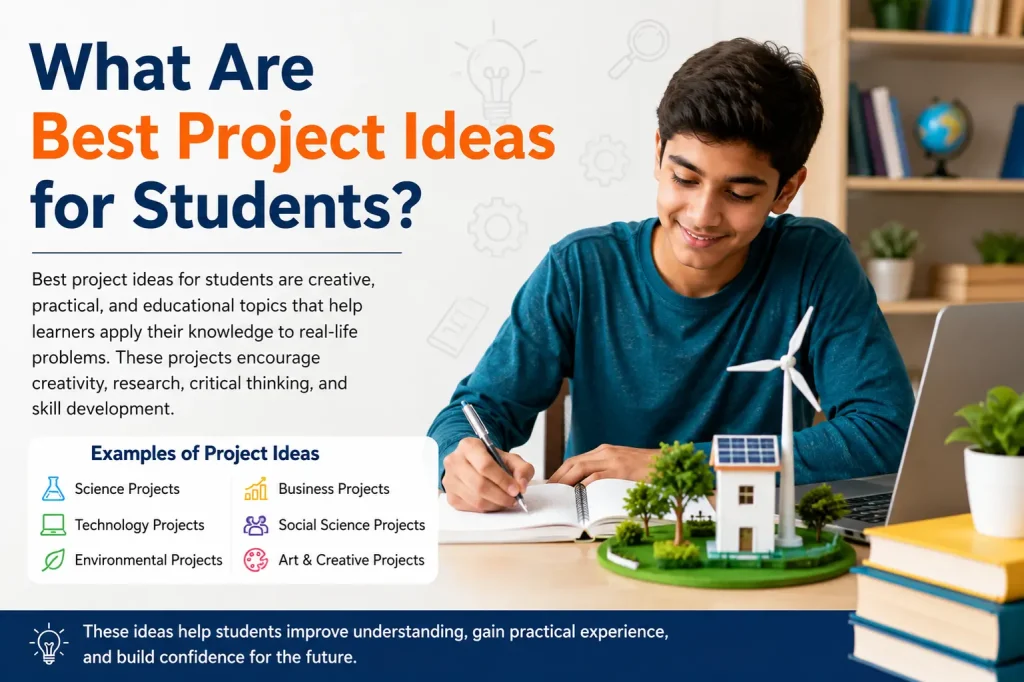
The best project ideas for students are creative, educational, and practical assignments that encourage learners to apply classroom knowledge to real-life situations. Instead of simply memorizing information, students explore topics through research, experimentation, design, and presentation.
A good student project should:
- Match the student’s skill level.
- Solve a real problem or answer an interesting question.
- Encourage creativity and innovation.
- Improve research and communication skills.
- Be achievable within the available time and resources.
Projects can be individual or group-based and may involve science, mathematics, technology, arts, business, literature, environmental studies, or social issues.
Examples include:
- Building a simple weather station.
- Creating a recycling awareness campaign.
- Designing a personal finance budget.
- Developing a basic mobile application.
- Conducting a local history research project.
- Designing a smart irrigation model.
- Writing a business startup proposal.
The right project transforms learning into an engaging experience while helping students develop valuable life skills.
Why Are Best Project Ideas for Students Important?

Student projects are much more than classroom assignments. They encourage active participation and help learners gain practical experience beyond textbooks.
Here are several reasons why projects are important:
- They improve understanding of academic concepts.
- They encourage independent learning.
- They develop critical thinking skills.
- They strengthen creativity and innovation.
- They improve research abilities.
- They enhance communication and presentation skills.
- They teach teamwork and leadership.
- They prepare students for future careers.
Projects also help students become confident learners who can solve problems and think independently. Instead of simply remembering facts, students learn how to apply knowledge effectively.
Step-by-Step Guide to Choosing and Completing the Best Project Ideas for Students
Step 1: Identify Your Interests
Start by selecting a subject that genuinely interests you.
Ask yourself:
- Which subject do I enjoy most?
- What problems would I like to solve?
- What hobbies can become project ideas?
Choosing a topic you enjoy makes the project much easier to complete.
Example
If you enjoy technology, consider creating a website or designing a simple app.
Step 2: Understand the Project Requirements
Carefully review your teacher’s instructions.
Consider:
- Deadline
- Word count
- Presentation format
- Budget
- Materials required
- Assessment criteria
Understanding expectations prevents unnecessary mistakes later.
Step 3: Brainstorm Multiple Ideas
Don’t settle for the first idea.
Write down several possible topics and compare them based on:
- Originality
- Difficulty
- Available resources
- Learning opportunities
- Practical value
This process helps you identify the strongest option.
Step 4: Research Your Topic
Gather information from reliable books, journals, educational websites, and classroom materials.
Focus on:
- Background information
- Existing solutions
- Recent developments
- Supporting evidence
Organized research builds a strong foundation for your project.
Step 5: Create a Project Plan
Break your project into manageable tasks.
Example timeline:
- Topic selection
- Research
- Planning
- Material collection
- Project development
- Testing
- Final presentation
Planning reduces stress and improves productivity.
Step 6: Collect Materials
Depending on your project, gather everything you need before starting.
Examples include:
- Cardboard
- Charts
- Software
- Survey forms
- Laboratory equipment
- Art supplies
- Recycled materials
Preparation saves valuable time during execution.
Step 7: Develop the Project
Now begin creating your project carefully.
Remember to:
- Stay organized.
- Follow your timeline.
- Record your progress.
- Test your work regularly.
- Make improvements whenever needed.
Quality matters more than speed.
Step 8: Prepare an Attractive Presentation
Present your project professionally.
Include:
- Title
- Objectives
- Methodology
- Results
- Challenges
- Conclusion
Practice explaining your work confidently.
Step 9: Review Everything
Before submission:
- Correct grammar mistakes.
- Check calculations.
- Verify facts.
- Improve visuals.
- Ensure neat formatting.
A polished project creates a positive impression.
Creative Best Project Ideas for Students
If you’re searching for inspiration, consider these engaging ideas across different subjects.
Science Projects
- Water purification model
- Solar-powered device
- Volcano experiment
- Air pollution monitoring
- Plant growth comparison
- Rainwater harvesting system
Technology Projects
- Personal portfolio website
- Mobile application prototype
- Smart home model
- Robotics project
- Coding game
- Cybersecurity awareness campaign
Business Projects
- Startup business plan
- Market survey
- Product branding strategy
- Budget planning exercise
- Small business case study
Environmental Projects
- Plastic waste reduction campaign
- School recycling program
- Community tree plantation
- Composting demonstration
- Energy conservation awareness
Arts and Creativity Projects
- Photography exhibition
- Handmade crafts
- Digital illustration portfolio
- Short documentary film
- School magazine design
Social Science Projects
- Local history research
- Community health survey
- Population study
- Cultural diversity presentation
- Volunteer service report
These ideas can be adapted according to grade level and available resources.
Benefits of Best Project Ideas for Students
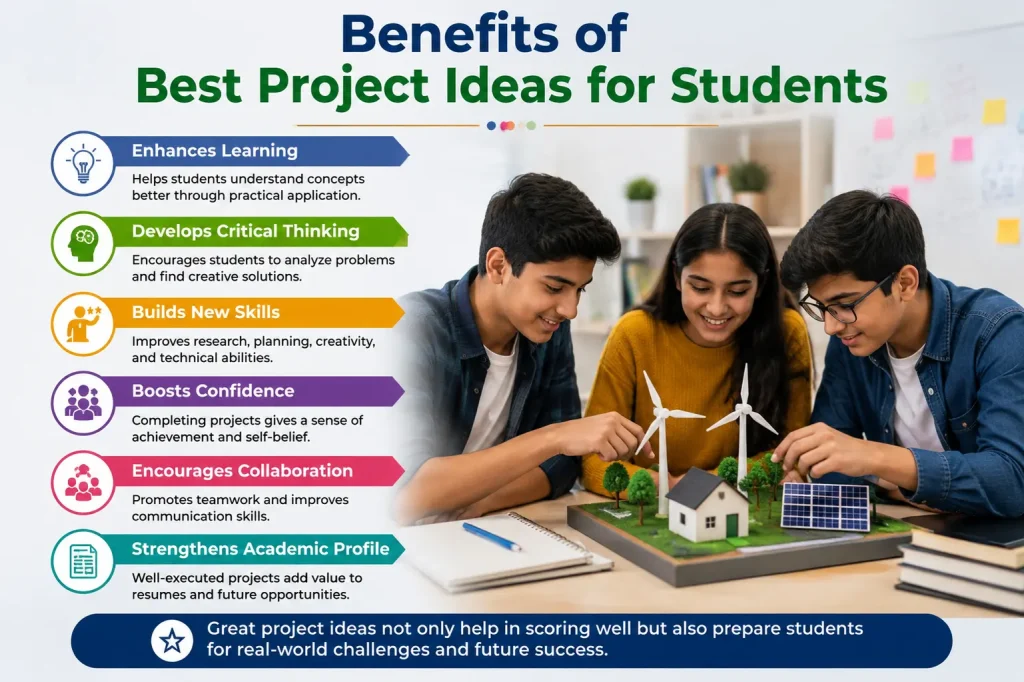
Working on meaningful projects offers numerous educational and personal advantages.
- Improves practical learning.
- Encourages independent research.
- Develops analytical thinking.
- Builds confidence.
- Enhances creativity.
- Strengthens communication skills.
- Improves teamwork.
- Develops leadership qualities.
- Encourages innovation.
- Improves time management.
- Makes classroom learning enjoyable.
- Increases problem-solving abilities.
- Enhances presentation skills.
- Builds responsibility.
- Prepares students for higher education and careers.
Students who regularly complete projects often become more confident and better prepared for future challenges.
Disadvantages and Risks
Although projects are beneficial, certain challenges may arise.
- Poor time management can delay completion.
- Choosing an overly difficult topic may reduce motivation.
- Limited resources can affect project quality.
- Group conflicts may slow progress.
- Insufficient research leads to weak conclusions.
- Budget limitations may restrict creativity.
- Lack of planning increases stress.
- Rushing before deadlines often lowers quality.
Fortunately, careful planning can minimize these risks.
Common Mistakes to Avoid
Many students make avoidable errors while working on projects.
Avoid these common mistakes:
- Choosing topics that are too broad.
- Starting research too late.
- Ignoring teacher instructions.
- Copying information without understanding it.
- Using unreliable sources.
- Poor organization.
- Weak presentation skills.
- Forgetting to proofread.
- Spending too much time decorating instead of improving content.
- Missing submission deadlines.
Learning from these mistakes helps create stronger projects.
How do I choose the best project idea?
Choose a topic that matches your interests, academic level, available resources, and project requirements. A practical and manageable idea usually produces better results than an overly ambitious one.
Can beginners complete advanced projects?
Beginners should start with simple projects that gradually build confidence. As skills improve, they can move toward more advanced and technical assignments.
How long should a student project take?
The duration depends on the project type. Simple assignments may require a few days, while larger research projects can take several weeks. Creating a schedule helps ensure steady progress.
Are group projects better than individual projects?
Both have advantages. Group projects develop teamwork and communication, while individual projects encourage independence, responsibility, and personal creativity.
What makes a project unique?
Original thinking, creative problem-solving, practical applications, accurate research, and attractive presentation all contribute to making a project stand out.
How can I improve my project presentation?
Practice speaking clearly, organize your slides or display materials, maintain eye contact, answer questions confidently, and explain your ideas using simple language supported by visuals and examples.
Should I include real-life examples?
Yes. Real-life examples make your project more practical, relatable, and engaging. They also demonstrate that you understand how theoretical concepts apply outside the classroom.
Expert Tips and Bonus Points
Experienced educators recommend focusing on learning rather than simply completing the assignment. A thoughtful project often receives better feedback than one filled with unnecessary complexity.
Helpful tips include:
- Choose quality over quantity.
- Start early.
- Keep detailed notes.
- Ask teachers for feedback during development.
- Use diagrams and charts where appropriate.
- Practice your presentation several times.
- Stay organized throughout the process.
- Learn from previous projects.
- Work consistently instead of rushing at the end.
- Focus on solving real-world problems whenever possible.
Bonus idea: Add a reflection section describing what you learned, the challenges you faced, and how you overcame them. This demonstrates maturity, critical thinking, and genuine engagement with the project.
Conclusion
The best project ideas for students inspire curiosity, strengthen academic knowledge, and develop practical skills that extend far beyond the classroom. A well-chosen project allows students to explore new concepts, solve meaningful problems, and express their creativity in unique ways. Whether you are interested in science, technology, business, arts, or social studies, selecting a topic that aligns with your interests and abilities can make the entire learning experience more rewarding.
Success begins with careful planning, thorough research, and consistent effort. Breaking the project into smaller tasks, gathering reliable information, managing your time wisely, and practicing your presentation all contribute to a polished final result. Equally important is maintaining originality and focusing on learning rather than simply finishing the assignment.
Remember that every project offers an opportunity to build confidence, improve communication, and strengthen problem-solving skills. Even if you encounter obstacles, each challenge teaches valuable lessons that prepare you for future academic and professional success.
By following the strategies and examples shared in this guide, you can confidently choose from the best project ideas for students, create an engaging project, and present your work with pride. Every successful project starts with one good idea, careful preparation, and a willingness to learn. With dedication and creativity, your next project can become a memorable achievement that supports your educational journey and inspires future success.